

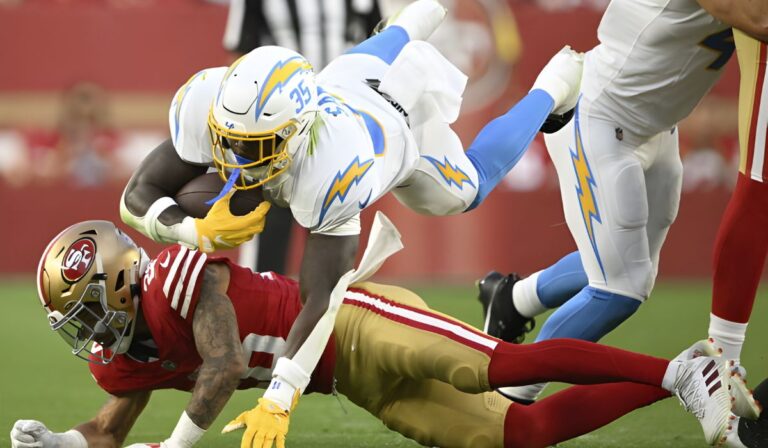
The Los Angeles Chargers vs 49ers Match Player Stats tell a deeper story than the final score alone. San Francisco beat Los Angeles 30–23 in the 2025 preseason finale, but the numbers show a competitive game built on quarterback rotation, second-half defensive pressure, and several strong depth-player performances. For fans searching for passing, rushing, and receiving details, this matchup offered a useful look at how both teams moved the ball, protected possessions, and tested players fighting for bigger roles before the regular season.
Because this was a preseason game, the most important takeaway is not only who won, but how individual players handled real game speed. The Chargers produced more total net yards, yet the 49ers made the more decisive plays late. Los Angeles had stronger passing volume, while San Francisco found timely offense and defensive scoring to control the final result.
Game Overview and Team Stat Summary
The Chargers finished with 321 total net yards, while the 49ers posted 238 total net yards. The Chargers also held the ball for 30:03, almost identical to San Francisco’s 29:57, which shows how close the rhythm of the game really was. The outcome came down to efficiency, turnovers, and situational execution.
Penalties also shaped the game. Los Angeles was flagged 11 times for 74 yards, while San Francisco had 12 penalties for 67 yards. For the Chargers, extra passing production helped offset mistakes. For the 49ers, the difference came from converting short-field chances and turning a defensive takeaway into points.
Chargers Passing Stats: DJ Uiagalelei Leads the Air Attack
DJ Uiagalelei was the main passing figure for Los Angeles, completing 16 of 31 passes for 170 yards, two touchdowns, and one interception. His stat line shows both promise and growing pains. The two touchdown passes gave the Chargers their best scoring moments, but the interception became a major turning point because San Francisco turned that mistake into a go-ahead defensive touchdown.
Trey Lance also appeared for the Chargers and completed 5 of 8 passes for 38 yards. Taylor Heinicke added 31 yards on 3-of-5 passing, giving Los Angeles three quarterbacks with live reps. Together, Chargers quarterbacks combined for 239 passing yards, which explains why their receiving numbers were stronger despite the loss.
49ers Passing Stats: Efficient Work From Tanner Mordecai and Carter Bradley
San Francisco’s passing game was not built on heavy volume, but Tanner Mordecai gave the 49ers an efficient first layer of production. Mordecai completed 10 of 13 passes for 103 yards, one touchdown, and no interceptions. That clean line mattered because he kept the offense on schedule and avoided a costly mistake.
Carter Bradley added another steady performance, completing 8 of 14 passes for 71 yards and one touchdown. His best moment came on a 22-yard touchdown throw to Terique Owens in the fourth quarter, a play that helped create separation after the game had been tied. The 49ers quarterbacks did not throw for huge yardage, but they protected the ball, delivered two passing touchdowns, and gave the defense enough support to finish the game.
Chargers Rushing Stats: Raheim Sanders Sets the Ground Game Pace
The Chargers’ rushing production was led by Raheim Sanders, who carried 13 times for 48 yards with a long run of 11 yards. In preseason evaluation, that kind of run profile matters because coaches want to see whether a back can create positive yards through contact.
Nyheim Hines added 21 rushing yards on nine carries, while Uiagalelei contributed a 13-yard run on his only rushing attempt. Los Angeles did not find a rushing touchdown, and that limited the offense near scoring territory. The Chargers had enough movement to stay balanced, but their ground game did not consistently punish San Francisco or create the late-game control that can protect a lead.
49ers Rushing Stats: Jeff Wilson Jr. Delivers the Key Touchdown
Jeff Wilson Jr. was San Francisco’s top rushing performer, finishing with 43 yards on 11 carries and one touchdown. His 5-yard score in the third quarter helped the 49ers tie the game and gave the offense needed momentum after Los Angeles had built a halftime advantage. Wilson’s stat line was efficient enough to matter, especially because the 49ers did not produce a large rushing total as a team.
Ke’Shawn Vaughn added 18 yards on nine carries, and Isaac Guerendo gained 13 yards on eight attempts. Tanner Mordecai also had 12 rushing yards, though quarterback rushing was not a major part of the 49ers plan. San Francisco’s rushing numbers were modest, but Wilson’s touchdown gave the unit value beyond raw yardage. In a close preseason game, one short-yardage finish can carry more weight than several average gains.
Chargers Receiving Stats: Dalevon Campbell and Oronde Gadsden II Stand Out
Dalevon Campbell led the Chargers receivers with four catches for 73 yards, including a long reception of 28 yards. His ability to stretch a play and create chunk yardage helped explain why the Chargers outgained the 49ers overall.
Oronde Gadsden II was another key target, catching three passes for 46 yards and one touchdown. His 25-yard scoring reception was one of the Chargers’ most important offensive plays. Jalen Reagor added three catches for 33 yards, while Luke Grimm caught three passes for 28 yards and a touchdown. The depth of the receiving group was a bright spot because several pass catchers contributed instead of one player carrying the entire passing game.
49ers Receiving Stats: Balanced Targets and Timely Touchdowns
San Francisco’s receiving leaders were not as statistically loud, but the group made the plays that mattered. Malik Turner caught three passes for 41 yards and led the team in receiving yardage. Demarcus Robinson added two catches for 30 yards and a touchdown, including a 22-yard score that gave the 49ers their first points of the night.
Robbie Chosen caught three passes for 24 yards, while Terique Owens made his lone catch count with a 22-yard touchdown. Luke Farrell, Skyy Moore, Isaiah Hodgins, Brayden Willis, Isaac Guerendo, and Ke’Shawn Vaughn also appeared in the receiving column. For the 49ers, the most valuable receiving stat was not volume, but touchdown efficiency.
Most Important Player Performances From the Match
For the Chargers, Uiagalelei’s two touchdown passes, Campbell’s 73 receiving yards, and Gadsden’s red-zone value were the headline numbers. Campbell’s yardage also stood out because explosive receiving plays can quickly influence roster conversations.
For the 49ers, Wilson’s rushing touchdown, Mordecai’s efficient passing, Bradley’s fourth-quarter touchdown pass, and Robinson’s scoring catch were central to the win. The defensive moment that changed the game was Curtis Robinson’s interception return for a touchdown. That play shaped the final score more than any single offensive stat.
What the Stats Say About the Chargers Offense
The Chargers offense showed depth, movement, and passing-game variety. A 321-yard total suggests Los Angeles had enough offensive structure to create opportunities, especially through short and intermediate throws. The team had multiple receivers involved, three quarterbacks with completions, and enough rushes to stay balanced.
At the same time, the stats reveal why the Chargers did not win. In close NFL games, a team can outgain its opponent and still lose if one or two key mistakes become scoring chances for the other side. That was the biggest lesson from this matchup.
What the Stats Say About the 49ers Offense
The 49ers offense was more selective than explosive. San Francisco finished with fewer total yards than Los Angeles, but the offense made enough high-value plays to support the defense. Mordecai and Bradley combined for two passing touchdowns without an interception, while Wilson provided the only rushing touchdown from either team. That created a cleaner scoring profile than the raw yardage total suggests.
San Francisco’s receiving numbers also show a practical preseason approach. The 49ers did not force the ball to one star player. Instead, they spread targets across several receivers, backs, and tight ends. That matters in evaluation because coaches need to see timing, route discipline, blocking effort, and special-teams value from players outside the top of the depth chart.
Why Passing, Rushing, and Receiving Stats Matter in Preseason Games
Preseason player stats require careful reading. A quarterback’s completion rate, a running back’s yards per carry, or a receiver’s yardage total matters, but context matters just as much. Players often face mixed defensive units, rotating offensive lines, and changing game plans. The best evaluation combines production with timing, decision-making, ball security, and situational impact.
In this Los Angeles Chargers vs 49ers matchup, the most helpful pattern is clear. The Chargers had broader offensive production, especially in the passing game, while the 49ers produced the bigger game-changing moments. That is why the stats are valuable: they show how Los Angeles built yardage and how San Francisco turned fewer yards into a seven-point win.
Final Thoughts
The Los Angeles Chargers vs 49ers Match Player Stats show a competitive preseason contest with useful offensive takeaways for both teams. Los Angeles had the stronger yardage profile, led by Uiagalelei’s 170 passing yards, Campbell’s 73 receiving yards, and Sanders’ 48 rushing yards. San Francisco answered with better finishing plays, including touchdown passes from Mordecai and Bradley, a rushing score from Wilson, and a defensive touchdown that changed the game.
For fans, the final score matters, but the player stats explain the full picture. The Chargers showed promising receiving depth and passing volume, while the 49ers showed efficiency, balance, and late-game execution. When passing, rushing, and receiving numbers are read together, this matchup becomes more than a preseason result. It shows how games are often decided by timing, turnovers, and the ability to turn limited chances into points.
Frequently Asked Questions (FAQs)
Who had the best passing stats in the Chargers vs 49ers game?
DJ Uiagalelei had the highest passing yardage for the Chargers, throwing for 170 yards and two touchdowns. For the 49ers, Tanner Mordecai was the most efficient passer, completing 10 of 13 passes for 103 yards and one touchdown without an interception.
Who led the Chargers in receiving yards?
Dalevon Campbell led Los Angeles with four receptions for 73 yards. His 28-yard long catch helped the Chargers create one of their strongest receiving performances of the game.
Who was the top 49ers rushing player?
Jeff Wilson Jr. led the 49ers rushing attack with 43 yards on 11 carries. He also scored San Francisco’s only rushing touchdown, which made his performance especially valuable.
Why did the Chargers lose despite having more total yards?
The Chargers lost because San Francisco made more decisive scoring plays. Los Angeles outgained the 49ers in total net yards, but an interception return touchdown, penalties, and missed finishing chances changed the outcome.
What was the most important stat from the game?
The most important stat was not only a yardage number, but the turnover impact. Curtis Robinson’s interception return for a touchdown gave San Francisco a major fourth-quarter advantage and helped decide the 30–23 result.
Read Also :- Houston Texans vs Dallas Cowboys Match Player Stats: Full Breakdown
