

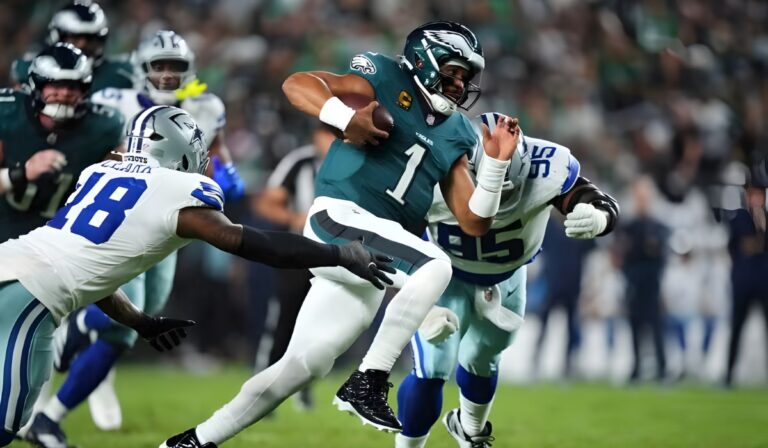
Dallas Cowboys vs Philadelphia Eagles Player Stats tell the real story behind one of the most exciting NFC East games of the 2025 NFL season. The final score showed a tight 24-21 Dallas win, but the deeper numbers explain how the Cowboys climbed out of a 21-point hole, how the Eagles lost control after a fast start, and which players shaped every major swing in the game. For fans, fantasy football players, and NFL analysts, this matchup offered more than rivalry drama. It gave a clear look at quarterback execution, receiving production, rushing efficiency, defensive pressure, turnovers, penalties, and late-game composure.
Dallas Cowboys vs Philadelphia Eagles Player Stats Overview
The most important part of this Dallas Cowboys vs Philadelphia Eagles Player Stats breakdown is the contrast between early dominance and late execution. Philadelphia built a 21-0 lead behind Jalen Hurts, A.J. Brown, and a sharp first-half offense. Dallas answered with a stronger second-half rhythm led by Dak Prescott, George Pickens, Javonte Williams, CeeDee Lamb, and Jake Ferguson. The Cowboys finished with more total yards, more first downs, and better late-game balance, while the Eagles had several strong individual performances but failed to turn them into second-half points. That split makes this game a perfect example of why raw stats matter, but timing, turnovers, and situational football matter just as much.
Quarterback Stats: Dak Prescott vs Jalen Hurts
Dak Prescott delivered the stronger full-game quarterback performance because he carried Dallas through pressure and made key throws when the game tightened. He completed 23 of 36 passes for 354 yards, two touchdowns, and one interception. Those numbers show volume, accuracy, and explosive passing value, especially because Dallas had to chase the scoreboard for most of the game. Prescott also added a rushing touchdown, giving him three total scores and making him the central figure in the Cowboys’ comeback. His connection with George Pickens changed the game, while his late completions helped set up the winning field goal.
Jalen Hurts also produced a strong stat line, completing 27 of 39 passes for 289 yards, one touchdown, and no interceptions. He added 33 rushing yards and two rushing touchdowns, giving Philadelphia all three of its offensive scores. Hurts looked sharp early, especially when spreading the ball to A.J. Brown, DeVonta Smith, and Saquon Barkley. The problem was not his total production; it was the offense’s second-half slowdown. The Eagles moved the ball well enough to win, but their inability to finish drives late allowed Dallas to erase the lead.
Cowboys Rushing Stats and Ground Game Impact
The Cowboys’ rushing attack was not flashy, but it gave the offense enough balance to keep Philadelphia honest. Javonte Williams led Dallas with 20 carries for 87 yards, showing strong patience and contact balance between the tackles. His production helped the Cowboys avoid becoming a one-dimensional passing team, even while trailing. A steady rushing presence also made play-action and intermediate passing routes more effective for Prescott as the game moved into the second half.
Dak Prescott added 9 rushing yards on five carries, but his rushing touchdown was the most important ground play for Dallas. That score tied the game in the fourth quarter and completed the emotional shift from Philadelphia control to Dallas momentum. Miles Davis added 24 yards on three carries, while KaVontae Turpin had limited rushing work. Overall, the Cowboys’ rushing stats were not dominant, but they were efficient enough to support the passing game and extend drives at key moments.
Eagles Rushing Stats and Saquon Barkley’s Quiet Game
Philadelphia’s rushing stats were surprising because the Eagles usually rely on physical ground control to protect leads. Jalen Hurts led the team with 33 rushing yards and two touchdowns, proving again how valuable he is near the goal line and in short-yardage situations. His rushing scores helped Philadelphia jump ahead early and gave the Eagles the kind of start most road teams dream about in a rivalry game.
Saquon Barkley, however, was held to only 22 rushing yards on 10 carries. That limited production had a major effect on the second half because Philadelphia could not consistently drain the clock or punish Dallas with long drives. Barkley did contribute as a receiver, but the lack of rushing efficiency made the Eagles more dependent on Hurts and the passing game. For a team trying to protect a lead, that imbalance became costly.
Cowboys Receiving Stats: George Pickens Leads the Comeback
George Pickens was the standout skill player for Dallas and one of the biggest reasons the Cowboys won. He caught nine passes for 146 yards and one touchdown, giving Prescott a reliable target in contested situations and open-field opportunities. Pickens made explosive plays, moved the chains, and delivered the kind of receiver performance that changes the energy of a game. His 43-yard catch in the fourth quarter was one of the most important plays of the night because it set up the tying touchdown drive and put Philadelphia’s defense under serious pressure.
CeeDee Lamb added four catches for 75 yards, while Jake Ferguson finished with five receptions for 60 yards. Their numbers may not match Pickens’ headline performance, but both players played important roles in spacing the field and keeping drives alive. KaVontae Turpin had a 48-yard reception, and Brevyn Spann-Ford caught a touchdown, giving Dallas production from multiple pass catchers. That receiving depth made it difficult for the Eagles to focus only on one target late in the game.
Eagles Receiving Stats: A.J. Brown and DeVonta Smith Shine
A.J. Brown led Philadelphia’s receiving group with eight catches for 110 yards and one touchdown. His early touchdown helped the Eagles set the tone, and his physical route running created problems for the Dallas secondary throughout the game. Brown’s ability to win against coverage remains one of Philadelphia’s biggest offensive strengths, and this performance showed why he is often the first player defenses must account for in the Eagles’ passing attack.
DeVonta Smith also had a strong game with six catches for 89 yards, including a 41-yard reception that helped Philadelphia build its early lead. Saquon Barkley added seven catches for 52 yards, giving Hurts a useful short-area option when Dallas pressured or covered deeper routes. Dallas Goedert, Grant Calcaterra, Dallas Cooper, and Xavier Gipson added smaller contributions. The Eagles’ receiving stats were strong overall, but the lack of second-half scoring kept those numbers from becoming a winning formula.
Defensive Stats, Turnovers, and Momentum Plays
Defensive stats do not always tell the full story, but turnovers and late stops were huge in this matchup. Both teams forced two turnovers, and both defenses recorded one sack. Philadelphia created early problems for Dallas, including a red-zone interception by Reed Blankenship and a fumble recovery after a KaVontae Turpin mistake. Those plays helped the Eagles build their 21-0 lead and made the Cowboys look unsettled in the first half.
Dallas responded with better discipline and stronger tackling after halftime. Sam Williams forced a key fumble on Saquon Barkley, and Kenneth Murray recovered it to stop a Philadelphia drive. Later, special teams and coverage work helped Dallas recover another late fumble, giving the Cowboys a short field. Even when Dallas failed to score a touchdown from that chance, the defensive and special teams pressure changed field position and kept Philadelphia from regaining control.
Team Stats: Total Yards, Third Downs, and First Downs
The team stats explain why Dallas had enough offensive power to complete the comeback. The Cowboys finished with 473 total yards compared to Philadelphia’s 339. That gap shows how much Dallas improved after a poor start and how explosive the Cowboys became through the air. Dallas also had 25 first downs, while Philadelphia finished with 19. In a close game, those extra possessions and extended drives mattered.
Both teams went 5-of-12 on third down, which shows that neither offense completely dominated situational football. The difference came from explosive plays, late possessions, and Dallas’ ability to finish the game with points. Philadelphia held the ball slightly longer, but Dallas created more yardage and more late-game scoring pressure. The Eagles also committed more penalties, which hurt their rhythm and extended the challenge of protecting a lead.
Key Performers Who Changed the Game
The biggest player performance belonged to Dak Prescott because he handled a difficult game script and turned it into a signature comeback. His passing yards, touchdown throws, rushing score, and final drive command gave Dallas the structure it needed to win. George Pickens was nearly as important because his catches repeatedly flipped field position and created explosive opportunities. Javonte Williams also deserves credit for giving Dallas a dependable rushing base.
For Philadelphia, Jalen Hurts was the most complete contributor. He threw efficiently, protected the football, and scored twice on the ground. A.J. Brown and DeVonta Smith both had winning-level receiving numbers, and their production showed how dangerous the Eagles can be when the passing game is in rhythm. The issue for Philadelphia was not a lack of star power. It was the inability to sustain that same offensive sharpness once Dallas adjusted.
What the Player Stats Reveal About the Rivalry
Cowboys vs Eagles games often come down to pressure, emotion, and small mistakes. This one followed that pattern perfectly. The Eagles had the better first-half identity, while the Cowboys had the better second-half response. The player stats show a rivalry where quarterback leadership, wide receiver explosiveness, and turnover timing made the difference. Dallas did not win because every phase was perfect. Dallas won because its top players made the most important plays at the most important moments.
This Dallas Cowboys vs Philadelphia Eagles Player Stats analysis also shows how quickly NFC East games can change. A 21-point lead looked safe when Philadelphia’s offense was rolling, but Dallas had enough passing strength and defensive toughness to stay alive. By the final drive, the game had shifted from an Eagles-controlled matchup to a Cowboys statement win. That is why player stats should always be read alongside game flow, not just as numbers in a box score.
Final Thoughts
Dallas Cowboys vs Philadelphia Eagles Player Stats: Full Game Breakdown shows that the Cowboys’ 24-21 win was built on resilience, explosive passing, and late defensive execution. Dak Prescott’s 354 passing yards and three total touchdowns made him the game’s defining player, while George Pickens’ 146 receiving yards gave Dallas the big-play spark it needed. For Philadelphia, Jalen Hurts, A.J. Brown, and DeVonta Smith produced strong individual numbers, but the Eagles could not finish the job after building a major early lead.
In the end, this game was a reminder that NFL player stats are most powerful when they explain the story behind the score. Dallas had the better late-game quarterback play, stronger total yardage, and enough defensive pressure to steal momentum. Philadelphia had a fast start and impressive receiving production, but the second-half shutout changed everything. For fans searching for Cowboys Eagles stats, NFL player breakdowns, quarterback comparison, rushing leaders, receiving leaders, and NFC East game analysis, this matchup remains one of the most complete examples of how numbers and momentum combine to decide a rivalry game.
Frequently Asked Questions (FAQs)
Who had the best player stats in the Cowboys vs Eagles game?
Dak Prescott had the best overall performance because he threw for 354 yards, scored three total touchdowns, and led the Cowboys back from a 21-point deficit. George Pickens was also one of the top performers with nine catches for 146 yards and a touchdown.
How did Jalen Hurts perform against the Dallas Cowboys?
Jalen Hurts played well statistically, throwing for 289 yards and one touchdown while adding two rushing touchdowns. His first-half production helped Philadelphia build a big lead, but the Eagles offense struggled to score after halftime.
Who led the Cowboys in receiving yards?
George Pickens led the Cowboys with 146 receiving yards and one touchdown on nine catches. His big plays were central to Dallas’ comeback and gave Dak Prescott a reliable target in high-pressure moments.
Why did the Eagles lose despite strong player stats?
The Eagles lost because they could not sustain their early offensive rhythm and were shut out in the second half. Turnovers, penalties, missed scoring chances, and Dallas’ late-game execution allowed the Cowboys to complete the comeback.
What was the biggest difference in the Cowboys vs Eagles player stats?
The biggest difference was Dallas’ passing production and total yardage. The Cowboys finished with 473 total yards, and Prescott’s 354 passing yards helped Dallas overcome Philadelphia’s early lead and win the game late.
Read Also :- Green Bay Packers vs Los Angeles Rams Match Player Stats and Top Performers
