

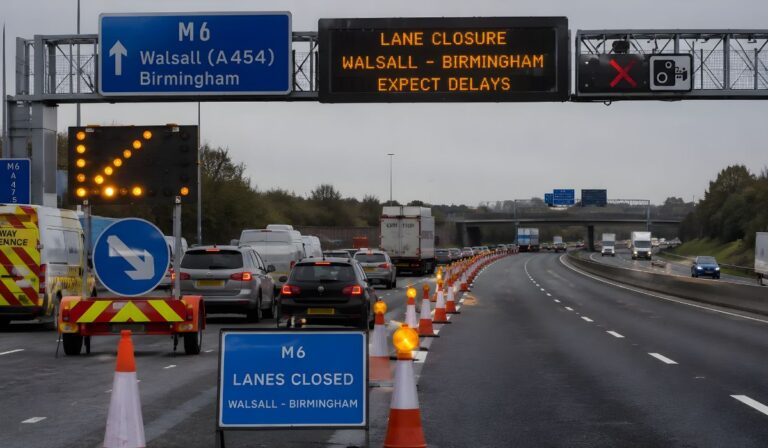
The M6 Walsall Birmingham Lanes Closure has become an important travel issue for drivers moving through one of the busiest motorway corridors in the West Midlands. For U.S. readers, the M6 works like a major interstate, linking cities, freight routes, airports, industrial areas, and daily commuter traffic. When lanes close between Walsall and Birmingham, the effect can spread quickly to nearby roads, local business parks, and connecting routes such as the A38(M), A34, A454, M5, and M54. That is why understanding the cause, timing, diversion routes, and driver advice matters before making a trip through this section. A little preparation can turn a stressful delay into a manageable journey, especially for commuters, delivery drivers, visitors, and families traveling across the West Midlands.
What the M6 Walsall Birmingham Lanes Closure Means
The phrase M6 Walsall Birmingham Lanes Closure usually refers to planned roadworks, emergency repairs, lane restrictions, slip road closures, or full overnight closures on the M6 around Walsall, Birmingham, and nearby junctions. In U.K. road language, a “junction” is similar to an exit or interchange, and a “carriageway” means one side of the motorway in a specific direction. Closures may affect one lane, several lanes, the hard shoulder, an entry ramp, an exit ramp, or an entire direction of travel. The exact impact depends on the work taking place, the junction involved, and whether the closure happens during the day, overnight, or during a weekend maintenance window. Because closure plans can change, drivers should treat online reports as helpful guidance, not a replacement for live travel information.
Why Closures Happen on This Busy Motorway
Lane closures on the M6 are not only about one single project. This route carries commuter traffic, long-distance travelers, delivery vehicles, heavy goods vehicles, airport traffic, and regional freight. With that much use, the road surface, bridges, safety barriers, drainage, signage, lighting, and roadside technology all need regular attention. Roadworks may include resurfacing worn lanes, replacing bridge joints, repairing crash barriers, upgrading smart motorway equipment, repainting lines, clearing drainage, or completing safety checks. Emergency closures can also happen after crashes, broken-down vehicles, fuel spills, debris, or severe weather, which means drivers should treat every update as time-sensitive. These delays can be frustrating, but the work is usually tied to safety, reliability, and long-term network performance.
Main Areas Affected Between Walsall and Birmingham
The most discussed section often sits around M6 junctions serving Birmingham, Walsall, Wednesbury, Great Barr, Aston, and the Black Country. Junction 6 is known for the Gravelly Hill Interchange, often called Spaghetti Junction, where the M6 connects with the A38(M) Aston Expressway. Junction 7 serves the Great Barr area, while Junction 9 is important for Walsall and Wednesbury. Junction 10 and 10a connect drivers toward Walsall, Wolverhampton, the M54, and the wider West Midlands motorway network. Because these junctions sit close together, a closure in one area can push traffic into nearby neighborhoods and create queues far beyond the original work zone. Drivers heading to Birmingham city center, Walsall town center, retail parks, hospitals, or industrial estates should pay close attention to the exact junction listed in any alert.
Roadworks and Maintenance Behind the Delays
Most M6 lane closures are scheduled to protect workers while essential maintenance is carried out safely. Resurfacing is one of the most common reasons because high traffic levels wear down the carriageway over time. Bridge joint replacement is another major cause, especially where structures carry constant motorway traffic and need strong, reliable expansion joints. Technology work can also require lane restrictions, including CCTV, signs, cabling, signals, and roadside equipment used to manage traffic flow. These projects may feel frustrating for drivers, but they help reduce long-term safety risks, improve road quality, and prevent more serious disruption later. A short overnight lane closure can be much less damaging than leaving a road defect until it requires emergency repairs during peak travel hours.
When Lane Closures Usually Take Place
Planned closures are often scheduled at night because traffic volumes are lower and crews can work with less risk. Drivers may see work windows between late evening and early morning, such as 9 p.m. to 6 a.m., although exact times can change depending on the scheme. Full closures may be used for larger tasks, while lane closures or hard shoulder closures may be enough for lighter work. Weekend closures can also happen when a job needs longer working time. Anyone driving overnight, leaving for an early flight, or moving freight on a tight schedule should check updates before departure because closures can begin the evening before they affect a morning trip. If a closure overruns because of weather, equipment issues, or unexpected repairs, early commuters may see delays even after the main work period ends.
Diversions Drivers Should Expect
Diversions for the M6 Walsall Birmingham Lanes Closure are usually designed to keep motorway traffic on the most suitable main roads instead of sending heavy vehicles through small residential streets. A diversion may guide drivers to the next available junction, local A-roads, or a signed route around the closed section. For example, drivers trying to reach Walsall, Wednesbury, Birmingham, or the M6 northbound or southbound may be redirected through routes using roads such as the A34, A38(M), A41, A454, A461, A4148, or nearby motorway connections. Following official diversion signs is safer than relying only on a phone app because apps may push traffic onto narrow streets that are not built for heavy volumes. Official routes are usually chosen for road width, safety, and the ability to handle a larger flow of vehicles.
How Delays Can Affect Commuters and Local Traffic
The biggest challenge is not always the closure itself, but the traffic pattern it creates. A single lane closure can slow traffic before the work zone, while a full closure can force vehicles onto local roads around Walsall, Birmingham, Great Barr, Aston, Perry Barr, and Wednesbury. Morning commuters may face longer trips if overnight closures overrun or if traffic builds near junctions. Evening drivers can also be affected when roadworks begin before late-night traffic has cleared. Local bus routes, taxi journeys, school runs, delivery schedules, and business travel may all feel the impact when motorway traffic shifts onto surrounding routes. For businesses, repeated delays can affect appointment times, delivery windows, staffing schedules, and customer service, especially when vehicles rely on the M6 every day.
Practical Travel Advice for Drivers
The best approach is to plan the journey before joining the M6, not after reaching the back of a queue. Check live traffic updates, official closure reports, and local travel alerts before leaving. Build in extra time, especially if traveling to Birmingham Airport, a hospital appointment, a rail station, a concert, or a work meeting. Keep enough fuel or battery charge, because stop-start traffic can take longer than expected. If a diversion is active, stay patient and follow the signed route. Sudden lane changes, last-second exits, and attempts to cut through unfamiliar side roads can increase the risk of collisions and make congestion worse for everyone. For regular commuters, it can also help to save two backup routes and compare them before each trip.
Advice for U.S. Readers Driving in the Area
Visitors from the United States should remember that the U.K. drives on the left, motorway lanes are marked differently, and junction numbers are used more often than exit names. The inside lane is the left lane, and the right lane is generally used for overtaking. Speed limits may drop through roadworks, and average speed cameras are common on major U.K. highways. A “slip road” means an entrance or exit ramp. If you rent a car and plan to travel between Birmingham, Walsall, Manchester, London, or the West Midlands airport area, review the route before starting and avoid assuming a normal interstate-style detour will be simple. Roundabouts, narrow local roads, and unfamiliar signage can make diversions feel different from U.S. highway detours.
Safety Tips During Lane Restrictions
Roadworks zones can be stressful, especially when traffic is heavy and signs appear quickly. Drivers should reduce speed, keep a safe gap, and watch for lane arrows, cones, temporary barriers, and workers near the carriageway. Heavy trucks need extra room, and sudden braking can cause chain-reaction traffic problems. If a vehicle breaks down, move left if safe, use hazard lights, and follow motorway safety instructions. During rain or darkness, visibility can drop around cones and narrow lanes, so calm driving is essential. The goal is simple: get through the closure safely, even if the trip takes longer than planned. No appointment, shortcut, or time saving is worth increasing the danger in a busy work zone.
Why These Closures Matter Beyond One Journey
The M6 is more than a local road between Walsall and Birmingham. It is part of a wider transport spine connecting the Midlands with northern England, London routes, ports, factories, warehouses, sports venues, universities, hospitals, and airports. When traffic slows here, the delay can affect delivery networks, workers, emergency response times, and local businesses. That is why road maintenance must balance two needs at once: keeping traffic moving today and keeping the motorway safe for the future. A well-managed closure may feel inconvenient, but poor maintenance would create bigger problems, longer shutdowns, and higher safety risks over time. For the West Midlands, a reliable M6 supports jobs, trade, tourism, and everyday movement across the region.
Final Thoughts
The M6 Walsall Birmingham Lanes Closure is a reminder that busy motorway routes need constant care, clear communication, and smart travel planning. Drivers should focus on the essentials: know the affected junctions, check the latest closure times, follow signed diversions, and allow extra time during overnight or peak travel periods. Whether the disruption is caused by roadworks, resurfacing, bridge repairs, lane restrictions, or an emergency incident, preparation makes the journey less stressful. For commuters, freight operators, local families, and U.S. visitors driving in the West Midlands, staying informed is the best way to avoid unnecessary delays and travel with more confidence.
Frequently Asked Questions (FAQs)
What is the M6 Walsall Birmingham Lanes Closure?
The M6 Walsall Birmingham Lanes Closure refers to lane restrictions, slip road closures, or full motorway closures affecting the M6 between Walsall and Birmingham. These closures may be planned for roadworks or introduced suddenly because of accidents, emergency repairs, or safety concerns.
Which junctions are most likely to be affected?
Closures often involve junctions around Birmingham and Walsall, especially areas near Junction 6, Junction 7, Junction 9, Junction 10, and Junction 10a. These points are important because they connect the M6 with local roads, the A38(M), the Black Country, Walsall, Birmingham, and other motorway links.
Why do M6 lane closures usually happen at night?
Night work helps reduce disruption because fewer vehicles are usually on the road compared with daytime commuter hours. It also gives crews safer access to lanes, barriers, signs, bridges, and road surfaces without stopping as much peak-hour traffic.
How can drivers avoid the worst delays?
Drivers should check official traffic updates before leaving, leave earlier than usual, and follow signed diversion routes when a closure is active. It is also smart to avoid last-minute route changes unless traffic information clearly shows a safer and faster option.
Are diversions always the fastest route?
Not always, but official diversions are usually chosen because they can handle larger traffic volumes more safely. Navigation apps may suggest smaller roads, but those shortcuts can become crowded quickly and may not be suitable for trucks, unfamiliar drivers, or late-night travel.
Read Also :- What Is Enntal? Meaning, History, Travel, Lifestyle, and Modern Uses
